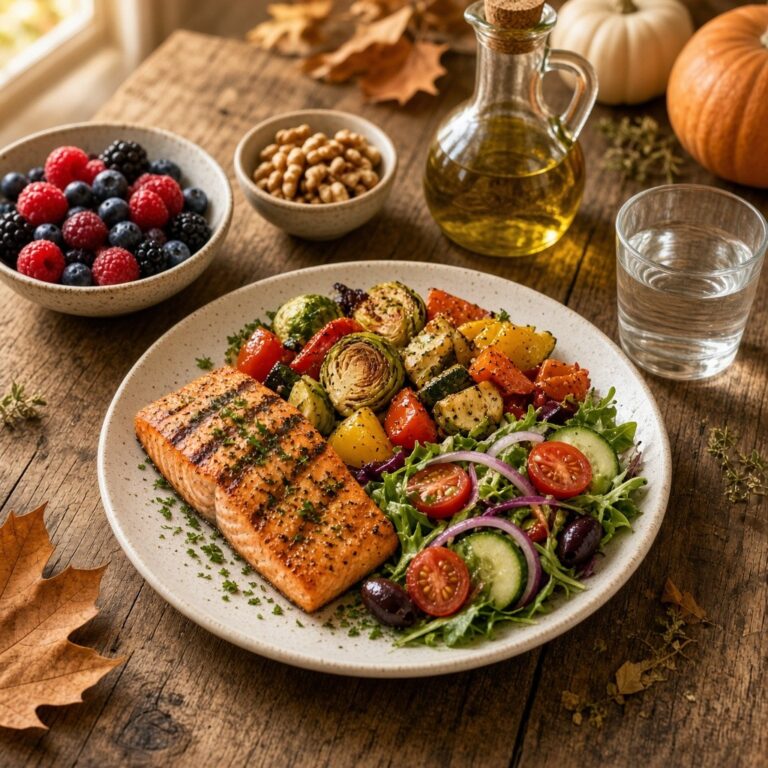


Thanksgiving is just around the corner. For many of us that means a full table, a full house, and a full calendar. It can also mean a full heart, or, if we’re honest, a tired one. Some years the holidays feel easy to be thankful for. Other years, gratitude takes real effort.
Here is the hopeful part: gratitude is not just a feeling that either shows up or doesn’t. It is a practice, and research suggests it is one that can shape how we feel, how we connect with the people we love, and maybe even how our brains respond over time. Today I want to look at gratitude through the whole person: body, soul, and spirit.
What Gratitude Is
Harvard Health describes gratitude as a thankful appreciation for what we receive, whether tangible or intangible. When we are grateful, we notice the goodness in our lives, and we usually recognize that at least part of that goodness comes from outside ourselves: from other people, from nature, or from our Heavenly Father. I love that, because it means gratitude naturally turns us outward, toward others and toward God.
What the Research Suggests
Some of the best-known research on gratitude comes from psychologists Robert Emmons and Michael McCullough. In one study, they asked people to write a few sentences each week. One group wrote about things they were grateful for, another about daily irritations, and a third about events that had simply affected them. As Harvard Health summarizes it, after 10 weeks the gratitude group was more optimistic and felt better about their lives. They also exercised more and had fewer visits to physicians than the group that focused on irritations. That is the body part of the story: what we focus on can ripple into how we take care of ourselves.
Gratitude may help people who are already struggling, too. In a study of nearly 300 adults who were starting counseling at a university, researchers asked one group to write a letter of gratitude to another person each week for three weeks, alongside their counseling. Compared with people who wrote about negative experiences or who only received counseling, the letter writers reported significantly better mental health four weeks and twelve weeks after the writing ended. Two details stood out to me. First, the benefits built slowly over time, so if you don’t feel dramatically different right away, be patient. Second, most people never actually sent their letters, and they still benefited.
What About the Brain?
About three months after that study began, the researchers invited some participants into a brain scanner. While doing a task designed to stir up gratitude, the people who had written gratitude letters showed greater activity in a part of the brain called the medial prefrontal cortex, an area linked with learning and decision making. The researchers are careful to say this is not conclusive, but it suggests that practicing gratitude may help train the brain to be more sensitive to gratitude down the road. In other words, gratitude grows with practice.
Gratitude Around the Table
The holidays bring us close to the people we love most, and sometimes to the people who test our patience most. Gratitude can help here, too. In a two-week study of couples who lived together, researchers found that when one partner felt grateful for something thoughtful the other had done, both partners tended to feel more connected and satisfied with the relationship the next day. The researchers called everyday gratitude a possible “booster shot” for relationships. The effects were small, and the study shows a pattern rather than proof, but it fits what I see in families: the little things matter.
So this season, try noticing the small kindnesses. The person who refilled your coffee. The relative who washed the dishes without being asked. The spouse who handled the errand you were dreading. Then say thank you, out loud and specifically. “Thank you for getting the kids ready so I could rest” lands very differently than a passing “thanks.”
Feed Your Spirit
Scripture invites us into gratitude again and again. “Give thanks to the LORD, for he is good; his love endures forever” (Psalm 107:1). And Paul writes, “Rejoice always, pray continually, give thanks in all circumstances; for this is God’s will for you in Christ Jesus” (1 Thessalonians 5:16-18).
Notice that Paul says in all circumstances, not for all circumstances. Gratitude does not mean pretending a loss doesn’t hurt or that a hard relationship is easy. If this season holds grief, an empty chair, or family tension, you can name that honestly before God and still look for the good that remains. Colossians 3:15 puts it simply: “Let the peace of Christ rule in your hearts, since as members of one body you were called to peace. And be thankful.”
If the holidays also bring a racing mind, you might find my recent article on finding calm this season helpful as well.
Simple Places to Start This Week
You don’t have to do all of these. Choose one or two:
- Count three blessings. Once a day, or once a week, write down three specific things you're grateful for. Be specific: not just "my family," but "my daughter's laugh at dinner tonight."
- Write a gratitude letter. Think of someone who made a difference in your life and write them a letter telling them how. You can decide later whether to send it.
- Thank someone in your head. No time to write? Pause and silently thank someone who did something kind for you.
- Notice the little things. At your next family gathering, look for one small kindness from each person and thank them for it.
- Pray with thanksgiving. Begin your prayers by thanking God for three things before you bring your requests.
- Start a family gratitude habit. Around the Thanksgiving table, invite everyone to share one thing they're thankful for this year. Keep it light and let anyone pass.
A Gentle Word of Caution
Gratitude is a healthy support, but it is not a treatment by itself. A 2021 review that pooled 27 studies with more than 3,600 people found that gratitude exercises had only a small effect on symptoms of depression and anxiety, and the authors recommended that people looking to ease those symptoms turn to approaches with stronger evidence. So please don’t use gratitude as a reason to push down real pain or to tell yourself you “shouldn’t” feel sad. If sadness, worry, or grief feels heavy, lasts for weeks, or is getting in the way of your sleep, work, or relationships, please talk with a licensed mental health professional or your physician. Reaching out is a sign of strength, not weakness.
Taking the Next Step
This article is for general education and encouragement. It is not a substitute for individual counseling or medical care. If something here stirred something in you, I gently encourage you to reach out to a licensed professional who can walk alongside you.
At Unity Health Solutions, I care for the whole person: mind, body, relationships, and faith. If you would like to work with me, please start with the New Patient Assessment Form. Once it is received, we will reach out to schedule your first visit. I see clients in my Midland office and by video for clients in Texas.
With a grateful heart,
Bobbi
Sources
- Harvard Health Publishing, Harvard Medical School. “Giving thanks can make you happier.” (August 14, 2021). Harvard Health: Giving thanks can make you happier
- Emmons, R. A., and McCullough, M. E. “Counting blessings versus burdens: An experimental investigation of gratitude and subjective well-being in daily life.” Journal of Personality and Social Psychology 84, no. 2 (2003): 377-389. DOI: 10.1037/0022-3514.84.2.377. Journal of Personality and Social Psychology: Counting blessings versus burdens
- Wong, Y. J., et al. “Does gratitude writing improve the mental health of psychotherapy clients? Evidence from a randomized controlled trial.” Psychotherapy Research 28, no. 2 (2018): 192-202. DOI: 10.1080/10503307.2016.1169332. Psychotherapy Research: Does gratitude writing improve the mental health of psychotherapy clients?
- Kini, P., Wong, J., McInnis, S., Gabana, N., and Brown, J. W. “The effects of gratitude expression on neural activity.” NeuroImage 128 (2016): 1-10. DOI: 10.1016/j.neuroimage.2015.12.040. NeuroImage: The effects of gratitude expression on neural activity
- Brown, J., and Wong, J. “How Gratitude Changes You and Your Brain.” Greater Good Magazine, Greater Good Science Center at UC Berkeley (June 6, 2017). Greater Good Magazine: How Gratitude Changes You and Your Brain
- Algoe, S. B., Gable, S. L., and Maisel, N. C. “It’s the little things: Everyday gratitude as a booster shot for romantic relationships.” Personal Relationships 17, no. 2 (2010): 217-233. DOI: 10.1111/j.1475-6811.2010.01273.x. Personal Relationships: It’s the little things
- Cregg, D. R., and Cheavens, J. S. “Gratitude Interventions: Effective Self-help? A Meta-analysis of the Impact on Symptoms of Depression and Anxiety.” Journal of Happiness Studies 22 (2021): 413-445. DOI: 10.1007/s10902-020-00236-6. Journal of Happiness Studies: Gratitude Interventions: Effective Self-help?
- The Holy Bible, New International Version (NIV): Psalm 107:1, 1 Thessalonians 5:16-18, and Colossians 3:15 (Bible Gateway). BibleGateway: Psalm 107:1 (NIV) · BibleGateway: 1 Thessalonians 5:16-18 (NIV) · BibleGateway: Colossians 3:15 (NIV)
Ready to take the next step?
If this article speaks to where you are, I would love to help. Start with the New Patient Assessment and we will schedule your first visit.